
6 min read · Updated 2026-11-09
When One Team Always Gets the Bad Meeting Time
A meeting can be possible for everyone on paper and still be fundamentally unfair.
If the same colleague joins at 06:30 every single week, or a remote team in Singapore always takes the 21:30 call because headquarters in London prefers mid-afternoon, the schedule may look solved. In reality, the cost quietly accumulates.
People rarely complain at first. Instead, they get tired, participate less actively, or gradually treat recurring meetings as low-priority obligations.
When scheduling across borders, attendance numbers do not tell the whole story. A sustainable schedule considers who carries the inconvenience and ensures that burden does not permanently fall on the same shoulders.
The organiser’s blind spot: the greenest slot is not always the best slot
When you look at a traditional meeting poll, it is tempting to pick whichever time slot has the most green checkmarks.
That is an understandable first step, but raw availability can hide severe imbalances:
- The same region is always outside local office hours: Having colleagues join at 20:00 every week creates fatigue, even if they marked themselves available.
- "Available" often hides reluctance: A participant might mark a slot because they can technically make it, not because it is a sustainable recurring time.
- Quiet team members carry the load: In mixed teams, junior or remote participants often avoid pushing back against senior staff or headquarters time zones.
- Lunch interruptions: Taking a meeting during lunch is manageable occasionally, but frustrating when repeated every week.
Availability counts bodies, not human energy. Sustainable global scheduling requires looking at how comfortable a slot is for each participant, not just whether they can dial in.
Why participants accept bad hours (and why they burn out)
Participants often accept uncomfortable meeting times with good intentions:
- "It is only one meeting, I do not want to hold everyone up."
- "Everyone else in the main office seems fine with this time."
- "I work remotely, so I feel obligated to be flexible."
An occasional evening or early-morning call is part of collaborating globally. But when the same slot repeats week after week, it stops feeling like a temporary compromise and starts feeling like an unspoken message about whose time matters most.
Over time, this damages meeting quality:
- Colleagues joining late at night contribute less and leave cameras off.
- Colleagues joining before breakfast are distracted by morning family routines.
- Decision-making slows down because fatigued participants agree just to end the call.
A meeting that happens on the calendar but drains your team's energy is a net loss.
4 practical rules for fair international scheduling
1. Rotate the inconvenience for recurring meetings
If your team spans North America, Europe, and Asia-Pacific, no single time slot will ever be convenient for all three at once. That is a mathematical reality.
Rather than forcing one region to take an awkward hour permanently, rotate the schedule across weeks:
| Cycle | Favoured regions | Inconvenienced region | Alternative |
|---|---|---|---|
| Week 1 | Europe & Americas | Asia-Pacific (late night) | Record call, async recap |
| Week 2 | Europe & Asia-Pacific | Americas (early morning) | Record call, async recap |
| Week 3 | Americas & Asia-Pacific | Europe (late evening) | Record call, async recap |
| Week 4 | Async week | None | No live meeting |
Even a simple two-way rotation—alternating between morning and evening every other week—immediately restores goodwill and shares the burden fairly.
2. Differentiate between office hours, lunch, and extended hours
Not all uncomfortable times are equal. When evaluating possible meeting windows:
- Core office hours (09:00–17:00): Full energy, standard working focus.
- Lunch hours (12:00–13:00): A soft inconvenience. If people must choose between shifting lunch by 30 minutes or joining a call at 21:00, lunch is almost always the preferred compromise.
- Extended hours (early morning / late evening): High personal friction. Use sparingly and rotate regularly.
3. Respect tentative answers ("Maybe")
When participants mark a time as tentative or "maybe," they are usually communicating:
- "I can move something if this is urgent, but I would prefer not to."
- "I can make this work this week, but please do not make this my permanent slot."
If Slot A has 8 participants all in core office hours, and Slot B has 8 participants but two of them marked "maybe" outside normal hours, Slot A is the superior choice even if both reach 100% attendance.

4. Separate essential decision-makers from optional attendees
Before trying to align ten schedules across four continents, ask:
- Who must actively speak and decide in real time?
- Who only needs to provide written input beforehand?
- Who only needs to read the final summary or action points?
Fewer required participants makes finding a fair, humane time dramatically easier.
How SyncWithTeam makes scheduling fairness visible
SyncWithTeam was built specifically to solve time-zone friction without tedious mental math:
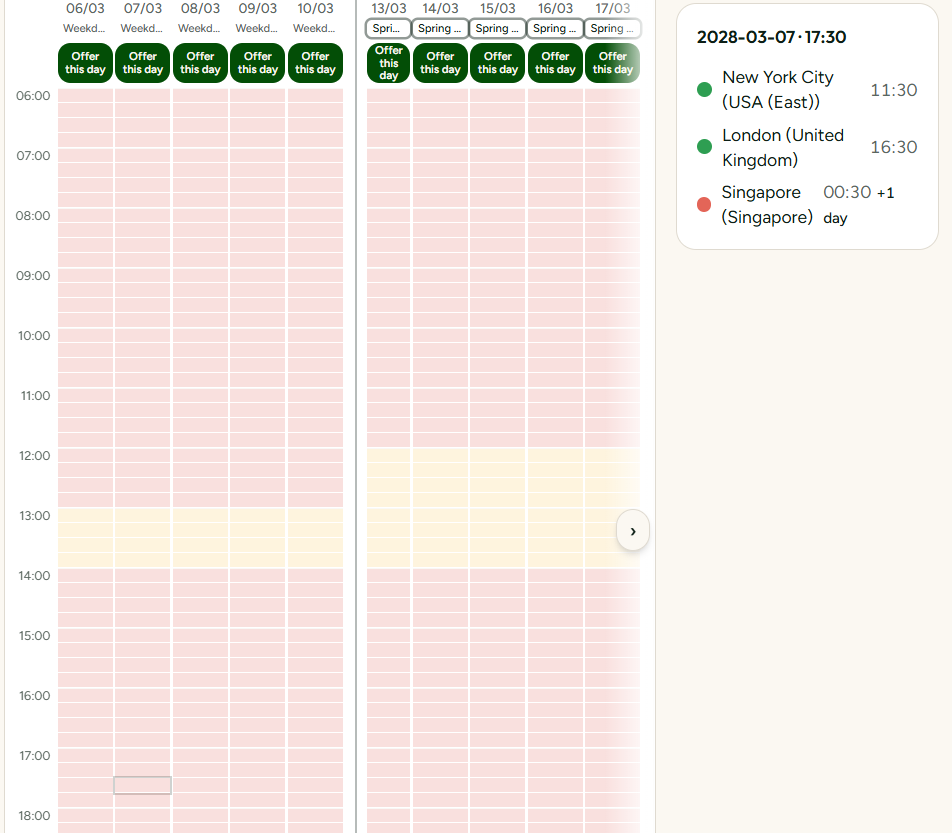
- Automatic comfort levels: The scheduler highlights core office hours, soft lunch hours, and extended hours per location, so you immediately see the human impact of every proposed slot.
- "Maybe" response brush: Guests can mark times with a yellow "Maybe — I'd have to move something" brush alongside the standard green "I can" slot, making schedule flexibility clear.
- Essential participants: Organisers can mark core stakeholders as essential (must-attend). If a proposed time misses an essential member or forces them outside office hours, the planner flags it instantly.
- Transparent local times: Every participant sees the proposed slots converted into their own city clock, eliminating confusion around daylight saving changes or UTC math.
💡 Put it into practice: Booking multiple meetings from one poll lets you rotate times across a series, and Finding the best time explains how windows are ranked.